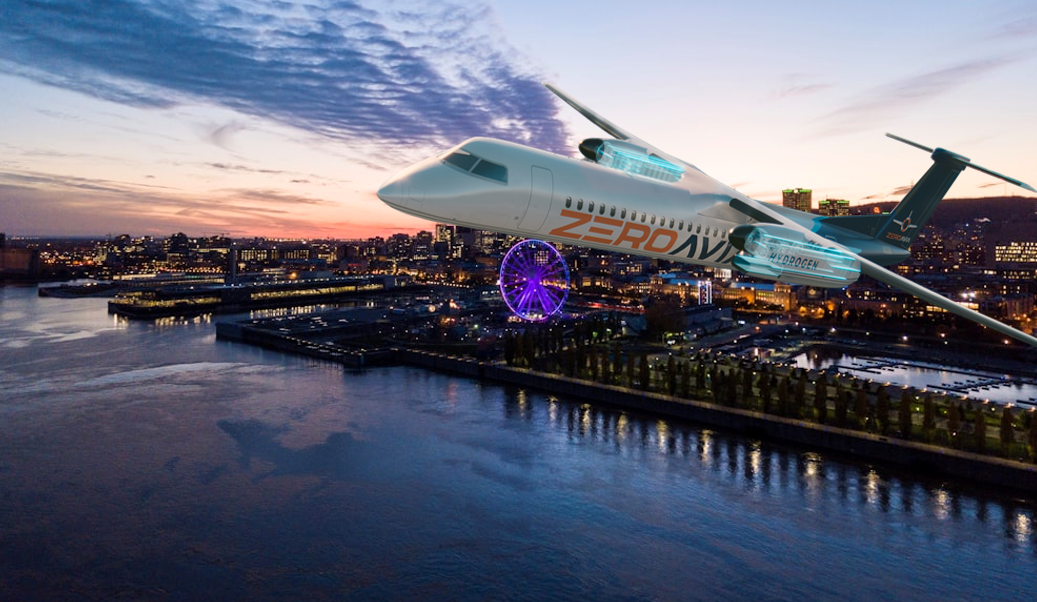
[Montreal, Canada, 21 May 2024] – Airbus and ZeroAvia have signed three respective Memorandum of Understanding (MoU) with Canada’s three busiest airports, Montréal–Trudeau International Airport (YUL), Toronto Pearson International Airport (YYZ) and Vancouver International Airport (YVR) to study the feasibility of hydrogen infrastructure at airports in Canada. The news was announced at a press event which took place at the International Aerospace Innovation Forum, organized by Aéro Montréal.
This is the first time that a feasibility study of this magnitude has taken place in Canada to pioneer hydrogen for aviation, with the three airports. It reflects the partners’ shared ambition to use their respective expertise to support the decarbonisation of the aviation industry (ICAO, ATAG and IATA) and to achieve net zero carbon emissions by 2050.
Air transport is prime in the country because of its wide-spread geography. Not only does it connect to international cities but is also an important means of supplying critical connectivity domestically. Commercial flights in Canada enable the flows of goods, investments, people and ideas that are the fundamental drivers of economic growth. Air transport in Canada is forecast to grow by 51% in the next 20 years under the “current trends” scenario. This would result in an additional 39.8 million passenger journeys by 2037. (Source IATA Economics)
This cooperation will provide better understanding of hydrogen aircraft concepts and operations, supply, infrastructure and refueling needs at airports, with the goal of developing the hydrogen aviation ecosystem across the country. The work will also collaborate to support the development of regulations and standards. Montreal is the home city of the International Civil Aviation Organization (ICAO) and collaboration is a key driver to support a global framework.
“Canada is one of the most promising regions for hydrogen hubs due to its natural resources.
Canada has great potential for hydrogen production from renewable energy sources such as
hydroelectric power. These first Canadian hydrogen partnerships enable us to cover the country from coast to coast. Hydrogen stands out as a key enabler as we pioneer a sustainable aviation future. We are very pleased to enter into this cooperation with partners fully engaged to take significant steps towards decarbonising aerospace. It fits perfectly with our strategy of deploying hydrogen aviation ecosystems in the most suitable parts of the world, now including North America.”


“We are bringing together Canada’s largest airports, the world’s largest aircraft manufacturer and the leading innovator in decarbonised propulsion technology, in order to progress the transition to hydrogen aviation. ZeroAvia flight testing demonstrates that hydrogen-powered commercial aviation is a prospect ahead of 2030, so we need to start working hard to prepare for the hydrogen infrastructure needed to support the aviation industry and airports as they step into a new golden age of clean flight.”
“ADM is committed to decarbonizing airport operations and improving air quality at its YUL and YMX sites. The use of hydrogen as a fuel for aircraft is a forward-looking solution that fits perfectly with these goals. This partnership will allow our organization not only to better prepare for the introduction of this alternative in our airport operations, but above all to adequately plan the infrastructure required to offer it at YUL as early as 2035. As Montréal is the world’s civil aviation capital, we are all the more proud that our city is playing a leading role in this sustainable innovation project.”


“Toronto Pearson is committed to making our own operations and those of the larger aviation industry more sustainable. Our partnership with Airbus and ZeroAvia is an extension of our ongoing efforts to adopt clean energy solutions, including the construction of our new hydrogen filling station.”
“The future of airports and their aviation partners will be built with innovative infrastructure that minimizes environmental impact.”
“We know when it comes to climate change, aviation isn’t the enemy, carbon is. Looking into the feasibility of airports as Hydrogen Hubs is an important step on the journey to net zero carbon emissions.
“The collaboration between Airbus, ZeroAvia and the three biggest airports in Canada will help identify the changes required in our industry and supporting ecosystem to meet carbon reduction goals.”

The use of hydrogen to power future aircraft is not only expected to significantly reduce aircraft emissions in the air, but could also help decarbonise air transport activities on the ground. In 2020, Airbus unveiled the first ZEROe concept with the ambition to bring to market the world’s first hydrogen-powered commercial aircraft by 2035. The development of the corresponding technology bricks is now underway in a global Research & Technology network.
Airbus also launched the “Hydrogen Hub at Airports” programme to jumpstart research into infrastructure requirements and low-carbon airport operations, across the entire value chain. To date agreements have been announced with partners and airports in ten countries including France, Germany, Italy, Japan, New Zealand, Norway, Singapore, South Korea, Sweden and the United Kingdom. ZEROe wishes to develop its hydrogen visibility and partnership network in North America. Therefore, there is a strong need to recruit partners in the region.
ZeroAvia has an active certification application for a powertrain (ZA600) for 10-20 seat aircraft, targeting market entry within the next couple of years, and is also developing a second engine (ZA2000) for 40-80 seat aircraft to follow soon after. In addition, the company is working to develop the hydrogen fuel ecosystem to support these clean propulsion systems at airports by developing unique production, storage and dispensing technologies, and by working with airport partners to plan for hydrogen operations in the near future.
Airbus has been in Canada for 40 years with more than 4,500 people working at the ten sites and offices of Airbus and its subsidiaries sourcing around C$2 billion annually from Canadian companies. Canada is also home of the A220 aircraft, where its main final assembly lines, pre-assembly line and main programme, engineering and customer services offices are located in Mirabel, Quebec.
To find out more about hydrogen and decarbonisation, visit airbus.com
About ZeroAvia
ZeroAvia is working to deliver the clean future of flight for the entirety of aviation by enabling electric propulsion. With a primary focus on developing hydrogen-electric (fuel cell-powered) engines, ZeroAvia has submitted its first powertrain for up to 20 seat planes for certification with a target of the end of 2025 and is working on a larger powertrain for 30–90 seat aircraft by 2027. Founded in California and now with thriving teams also in Everett, WA and the United Kingdom, ZeroAvia has secured experimental certificates to test its engines in three separate testbed aircraft with the FAA and CAA and passed significant flight test milestones. The company has signed a number of key engineering partnerships with major aircraft OEMs and has nearly 2,000 pre-orders for engines from a number of the major global airlines, with future revenue potential over $10bn. For more, please visit ZeroAvia.com, follow @ZeroAvia on Facebook, Twitter/X, Instagram, LinkedIn, and YouTube.
About Airbus
A commercial aircraft manufacturer, with Space and Defence as well as Helicopters Divisions, Airbus is the largest aeronautics and space company in Europe and a worldwide leader. Airbus has built on its strong European heritage to become truly international – with roughly 148,000 employees at 180 locations globally. The company has aircraft and helicopter final assembly lines across Asia, Europe and the Americas.
Airbus Press Contact
Amélie Forcier
Airbus Canada
1-514-452-5279
Philippe Gmerek
Airbus
+33 613 193 727
philippe.gmerek@airbus.com
About Montréal-Trudeau International Airport
ADM Aéroports de Montréal is the airport authority for the Greater Montréal area responsible for the management, operation and development of YUL Montréal-Trudeau International Airport, which is certified 4 stars under the Skytrax World Airport Star Rating program, and of YMX International Aerocity of Mirabel. Montréal–Pierre Elliott Trudeau International Airport (formerly Montréal–Dorval International Airport) is the main Canadian airport East of the Great Lakes, serving Québec, Atlantic Canada as well as Eastern Ontario and Northern New England. Each year some 30 air carriers transport more than 13 million passengers via Montréal-Trudeau; there are direct flights to and from about 130 regular and seasonal destinations in Canada, the United States and internationally. Owing to its geographic location, Montréal is a major hub for air traffic between Canada and Europe.
About Toronto Pearson
The Greater Toronto Airports Authority is the operator of Toronto Pearson International Airport, Canada’s largest airport and a vital connector of people, businesses and goods. Toronto Pearson has been named “Best Large Airport in North America serving more than 40 million passengers” for five years in a row by Airports Council International (ACI), the global trade representative of the world’s airports. In recognition of its Healthy Airport program, ACI has also awarded Toronto Pearson the “Best hygiene measures in North America” award for three years running, and Toronto Pearson was the first Canadian airport to receive ACI’s global health accreditation for its response to COVID-19. For our corporate X channel, please visit @PearsonComms. For operational updates and passenger information, please visit @TorontoPearson/@AeroportPearson on X. You can also follow us on Facebook or Instagram.
Toronto Pearson International
Airport
media.relations@gtaa.com
1-416-776-3709
About Vancouver International Airport
Vancouver International Airport (YVR) is a diverse global hub that connects people, cargo, data, and ideas and serves as a platform for our community to come together and thrive. We are motivated by supporting regional economic development and making a positive difference in the lives of British Columbians. We do this with a focus on serving our passengers, partners, workers, and community through digital modernization, climate leadership, reconciliation, and financial sustainability.
Vancouver International Airport media_relations@yvr.ca
1-604-880-9815
We use cookies to improve your experience on our site. By using our site, you consent to cookies.
Manage your cookie preferences below:
Essential cookies enable basic functions and are necessary for the proper function of the website.