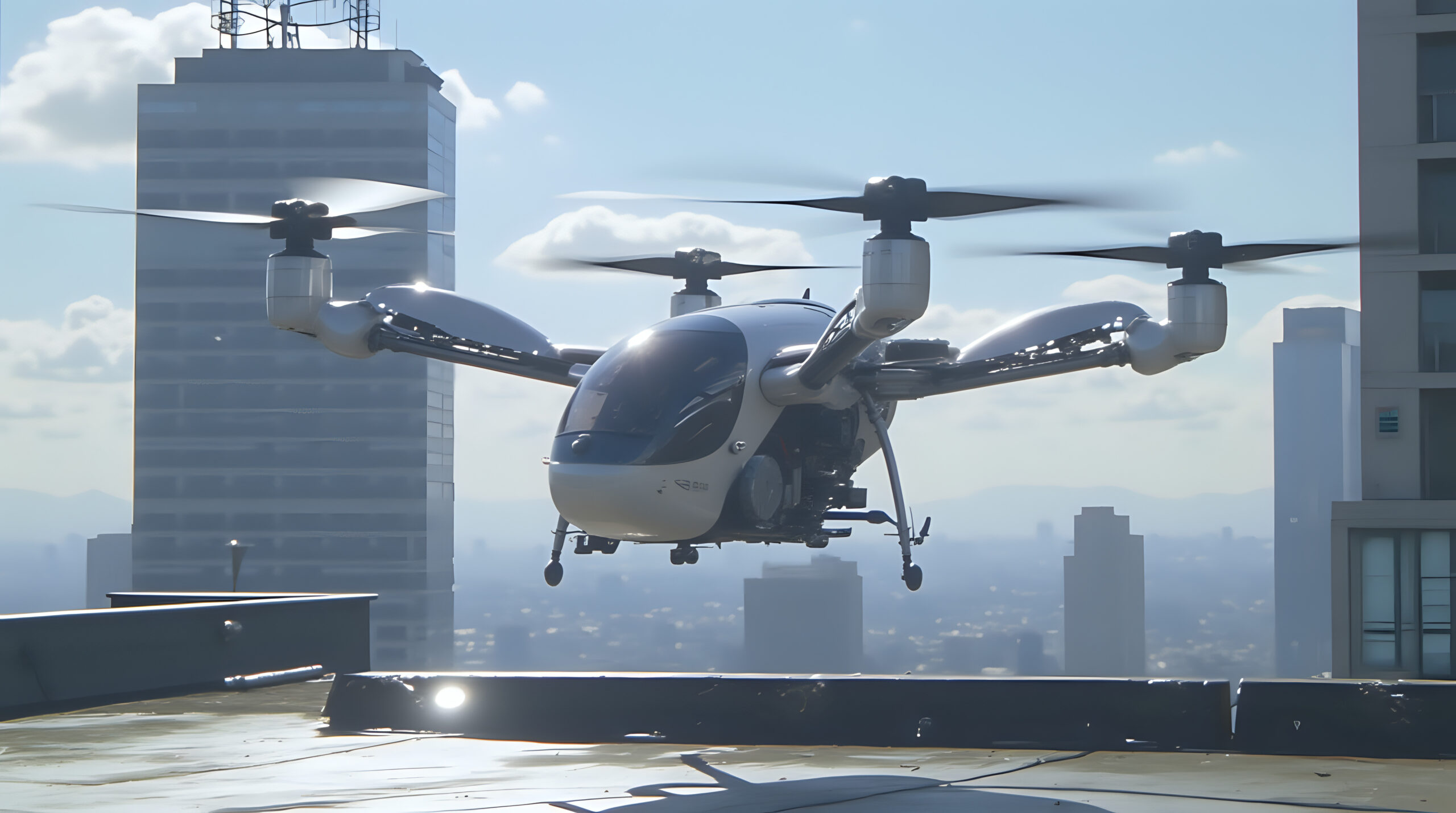
Nestled in the quiet south west corner of England’s Cotswolds are two companies trying to revolutionise the future of air travel. If you are reading here on ZeroAvia’s blog, you likely know about what we’re doing, but just a few hundred meters from our hangar at Cotswold Airport is the main hangar of Vertical Aerospace, a UK leader in the development of electric Vertical Takeoff and Landing (eVTOL) aircraft.
A lucky few of our team have happened to be at the airfield when Vertical’s VX4 has been in flight test. That’s been pretty jaw dropping, but what is a novelty today could soon be commonplace given the development and commercial milestones that are being passed by OEMs in this new space all over the world. It poses an interesting question as to whether these air taxis will be by default battery-electric (beVTOL), or whether hydrogen fuel cells will be considered in the future to power the electric motors (hydrogen-electric VTOL or heVTOL for short).
Breakthrough flights are being conducted all the time by aspiring eVTOL OEMs, all with various class and passenger payload targets. Starting close to home, in September last year Vertical conducted its first full wingborne test flights, soon after received its permit to fly for a piloted transition from hover to wingborne flight, a milestone achievement that the company completed in April 2026. Archer completed it’s flight test campaign of the four passenger Midnight eVTOL in launch market the UAE in November. Back in the Summer, Joby Aviation made history in California with the first flight between two public airports. BETA Technologies advanced it’s ALIA eVTOL (5 PAX) through piloted flight test. Canada’s Horizon Aircraft – which has struck an agreement with ZeroAvia to work together on developing regional hydrogen-electric VTOL air travel – became the first company to achieve a stable transition using a novel fan-in-wing design in its Cavorite X7 hybrid eVTOL prototype in May of last year.
On the other side of the world, Japanese startup SkyDrive made a major statement with its flight campaign during the Osaka Expo. This month Chinese start-up AutoFlight successfully conducted a transition flight with its five-tonne, 10 seat electric vertical take-off and landing (eVTOL) aircraft. The phenomenon is global and hyper competitive.
Regulatory approvals are making headway beyond the demo flights. Joby announced in November that it has entered the final stage of type certification with the FAA and expects TIA testing this year. Beta aims for 2027/2028 certification of ALIA eVTOL.
The progress is aided by regulators efforts and government policy. While the FAA did recently delay the publication of its safety continuum for powered-lift aircraft, this decision was driven by the learnings being derived from multiple certification programmes and now targets mid-2026. Last month the FAA reorganization created the new Office of Advanced Aviation Technologies, which is designed to oversee the integration of drones, eVTOLs, and other emerging aviation technologies into U.S. airspace. In July, EASA introduced specific acceptable means of compliance and guidance material to the requirements for the operation of manned vertical take-off and landing, creating a comprehensive regulatory framework. The UK CAA published its eVTOL delivery model (CAP3169) in September.
Perhaps most exciting, the U.S. Department of Transportation’s eVTOL Integration Pilot Program (eIPP) is set to select participants in early 2026, enabling controlled pre‑certification operations within a matter of months. As former FAA acting administrator Billy Nolen predicted during ZeroAvia’s Hydrogen Aviation Summit, 2026 will be a pivotal year for eVTOL regulation and adoption.
Plans for commercial launch therefore edge closer. Archer plans to operate its aircraft in UAE in the coming year, and Vertical plans full certification by 2028. Archer even plans to be flying at the Olympic games in Los Angeles in 2028.
While naysayers will quibble on certification and EIS timelines, when eVTOL aircraft do eventually arrive, the impact is thought to be gargantuan. According to Aviation Week predictions, the world will see 12,000 eVTOL aircraft delivered by 2040, and 33,000 delivered by 2050, with around 25,000 in service. For context, there are around 12,000 Airbus A320s in service today, the world’s most-utilised airliner. While the demographic of customer is always a talking point, at these predicted volumes, it’s hard to dismiss the eVTOL sector’s aspirations of a mass-market transport modality.
These early introductions will deploy battery-electric systems but that will be a significant limit on range, endurance and operational capability. According to an Intelligent Energy White Paper, where a 4-seat plus pilot design is limited to 90 km in range with batteries, fuel cell equivalents would be capable of some 645 km with the same payload – a more than 600% increase.
This analysis is also based on the use of gaseous hydrogen storage – the most mature technology, but with considerably lower gravimetric energy density than liquid hydrogen storage systems. The inevitable progression to LH2 systems will provide a nearly 10 fold increase in range for heVTOLs versus beVTOLs. This is not all theoretical; Joby has already flown an eVTOL aircraft fitted with liquid hydrogen tanks, achieving an impressive 523 miles (840 km) flight.
A related challenge is endurance. With the aspiration of keeping costs down for consumers to ensure advanced air mobility isn’t just the preserve of the wealthy, being able to fly multiple missions without downtime is crucial.
The theoretical vehicle we examined earlier with the 600% improved hydrogen range, would also be capable of performing more than three times the number of 30km short hops without a refuelling event when compared to the battery equivalent. The ability to store more energy means refuelling/recharging doesn’t need to be everywhere, reducing infrastructure capex and expensive grid connections with long timelines for delivery.
According to a study by Argonne National Labs, a tilt rotor hybrid eVTOL (fuel cell + battery) could boast 26% lower total cost of ownership than its battery-only equivalent ($0.49 per passenger mile, versus $0.66).
Once you have point to point travel that hops over congestion, it’s not realistic to think people will want to stick with a limited radius, boxing them in.
As eVTOLs become a common fixture across our skies and people take their first trips, they will want to see the convenience benefits extended to more and more trips. That means increasing range and reducing costs, and hydrogen fuel cell integration is the key vector for delivering both, without compromising on environmental benefits.
ZeroAvia’s 200kW SuperStack Flex fuel cell power generation system offers an effective range extension solution for eVTOL and other aircraft compromised by battery weight and energy storage capacity, while remaining zero emission and low noise. ZeroAvia is supplying these systems to the defence sector and in active discussions with prospective civil aviation-focused OEMs.
The SuperStack Flex can enable both electric propulsion and enhanced on-board electrical power generation with greater power density than battery systems. It unlocks all of the benefits of electrical operation – lower thermal and noise signatures, reduced maintenance costs, enhanced reliability and zero-emissions – and with significantly enhanced endurance. With Design Organisation Approval granted by the UK CAA in November, ZeroAvia is well positioned to deliver the first fuel cell systems for aviation with regulatory approvals. Securing this approval could be a pivotal moment for broadening air taxi adoption.
Download the SuperStack Flex brochure here.
We use cookies to improve your experience on our site. By using our site, you consent to cookies.
Manage your cookie preferences below:
Essential cookies enable basic functions and are necessary for the proper function of the website.