


Just under 100 miles due west of London stands Hangar C2 at Cotswold Airport in Kemble. A former Royal Air Force base that was active in World War II – and where you still see the occasional Spitfire taking off – this historic airport is now the home of ZeroAvia’s lead R&D and flight testing hub in Europe. With this rich aviation legacy a daily presence for our team, the 80th anniversary of D-Day last week gave us a chance to reflect on historical turning points.
It was just after midnight almost exactly 80 years ago that one of the most important events of the 20th Century came to life on the shores of Normandy Beach in France. D-Day was not only a major turning point in the war, its impact on the war’s outcome helped manifest the transformational changes that shaped the modern world.
While the amphibious landing with the soldiers jumping out of boats and charging up the beach is the most widely known visual representation of D-Day, there was also a supporting airborne operation that played a critical role in the day’s outcome. As you might imagine, aviation back in 1944 was a much smaller scale – in virtually every way – operation.

Coming just after the “Golden Age of Flight” that took place in the 1920s and ‘30s, aviation in 1944 – five years into World War II – was primarily focused on military uses. Planes such as the Supermarine Spitfire (UK), B29 Superfortress (US) and Messerschmitt Me 163 (Germany) were among the aircraft roaming the skies and receiving virtually all the investment and resources.
In general, flying commercial in 1944 meant slow, low-altitude (<15,000 feet) planes with no cabin pressurization and a barely more than a couple dozen passengers. Most people made long trips by train or boat, not planes.
As with other historical times of war and intense activity (e.g., development of the atomic bomb in 1945, the Space Race of the 1960s), technological progress sped up significantly out of necessity and soon thereafter showed up as industries, products and experiences in people’s lives. Aviation was no exception. Transformation was just around the corner from D-Day.
While we are on the subject of D-Day, let’s use the 26-year period between1944 and 1970 as an example transformation timeframe. Not only are there neat aerospace milestones at either end, but, handily, 26 years is exactly how long we now have before 2050 (as we will discuss in more detail below).
Over this period, from an aircraft perspective, everything changed – at scale!
Speed, altitude and passenger capacity are some examples. From a numbers standpoint (approximate):
Speed: 200 knots vs. 500 knots
Altitude: 15,000 feet vs. 40,000 feet
Passenger capacity: 30 vs. 400 (Douglas DC-3 compared to Boeing 747)
A few of the significant advancements included:
Cabin pressurization: This was non-existent until the need for longer-range, higher-altitude military flights became a forcing function. Prior to the invention of a cabin pressurization system in the late 1930s by American company Garrett AiResearch for use in the B29 Superfortress during the war, cruising altitudes in commercial flights were limited to ~10,000 feet, at which point the lack of oxygen becomes problematic for passengers and can lead to hypoxia (altitude sickness) and other problems. By 1970 that altitude limit had quadrupled.
Jet engines: As with other technological advancements, jet engines were under development by different sides of the war effort because of the potential military advantages, but were barely used in the war, and not at all in commercial aviation. While both the Germans and British developed workable jet engines by the time of D-Day, they weren’t very useful because of excessive fuel consumption and slow speed. But in the post-war period RAF Air Commander Sir Frank Whittle’s turbojet engine technology was improved in the US by General Electric and UK by Rolls-Royce for military planes. And shortly thereafter another American company, Pratt & Whitney, took those improvement lessons and others learned from German efforts to develop an engine that went a long way toward resolving the thrust and fuel consumption issues. The resulting turbojet engine had two compressors; each of which drew power from its own turbine. It was this engine which powered the Boeing 707 and DC-8 commercial airliners. Speed more than doubled as a result.
Popularity: By 1955, travel by plane exceeded trains in the US for the first time. Two years later airplanes exceeded ships as the most popular method of crossing the Atlantic. As the technology and overall experience improved, fares became more attractive and more people flew, creating a flywheel of positive momentum.
The Next Big Thing: The biggest aviation story of 1970 was arguably the debut of the Boeing 747. It carried more than twice the number of passengers (400) than the plane it was built to replace, the 707. It was also much more efficient to operate from a seat-miles standpoint. And instead of being propeller-driven like all commercial planes in 1944, it was powered by four turbofan jet engines.
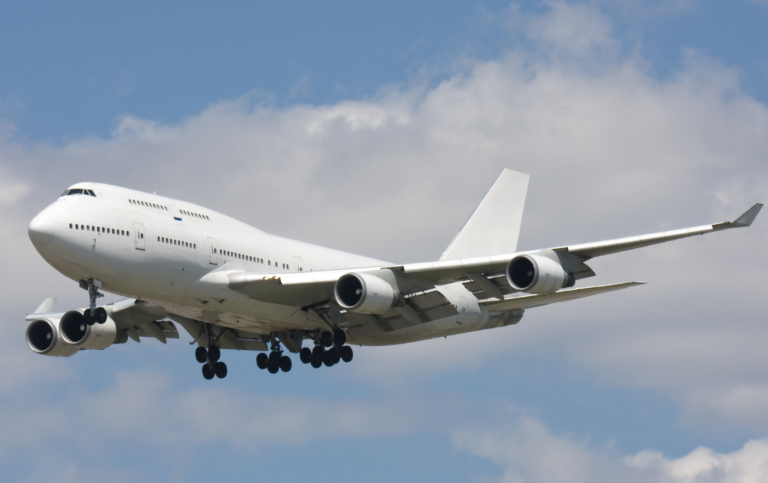
There’s certainly a case to make that the arrival of the 747 on the scene was a major turning point in aviation history writ large and the forebearer of today’s bigger, faster and higher-capacity aircraft.
As with many things, in aviation the past informs the present – and the future. All the technological advancements over the decades have had positive and negative effects.
On the positive side of the ledger, today we can fly higher, faster and farther than ever before. For example, it’s possible to fly direct from New York to Shanghai (on an Airbus A350 jet)– a journey of almost 10,000 miles – and book it in minutes from a website. Depending on the type of ticket you purchase, sleeping in a bed in your own walled off pod is an option, among other modern-day amenities unthinkable in 1970, never mind 1944.
On the negative side of the ledger, that type of convenience and technological capability comes at a cost beyond money. Perhaps the biggest net-negative is climate impact.
Today, aviation is the fastest-growing source of greenhouse gas emission (GHG). Additionally, aviation traffic is expected to more than double over the next three decades. By 2050, aviation’s climate overall climate impact is expected to reach as high as 50%.
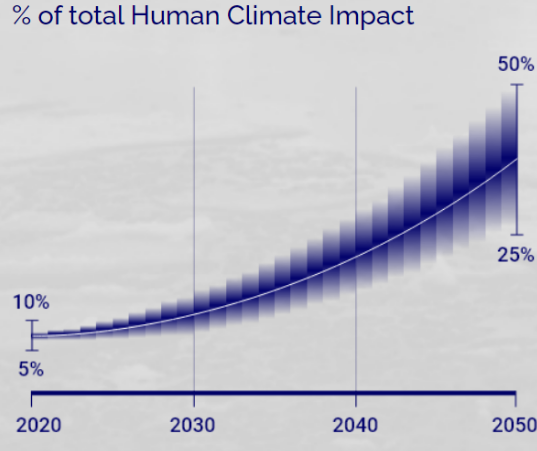
The year 2050 is a bellwether for climate goals and expected impact. A quick online search will turn up major global climate initiatives such as the European Union’s target of net-zero greenhouse gas emissions, predictions on how climate will impact our lives and everything in between.
It’s clear that meeting ambitious climate goals like the EU’s in 26 years won’t happen without a massive reversal in aviation’s impact. That begs the question: can this and other climate goals realistically be met?
While it’s impossible to answer that question, history does provide us with clues that make it seem within the realm of the possible to make today a turning point in the 26-year march to net-zero greenhouse gases for an entire continent and (hopefully) beyond.
At ZeroAvia, our long-term plan has 200-passenger commercial airliners flying with zero-emission, hydrogen-electric powertrains by 2040. And we expect our engines to be powering even bigger planes flying longer distances by 2050.
A Lot Can Happen in 26 Years. A Lot Needs to Happen in 26 Years.
One way to look at the climate challenge ahead of us is that we have 26 years to deliver transformational change to hit the ambitious net zero targets like the EU’s. It might seem like an insurmountable challenge given the complexity and breadth of the challenge in what is a relatively short time frame. Then again, think about how much changed just with aviation technology between 1944 and 1970.
ZeroAvia believes the path to truly clean aviation is a realistic goal for 2050. In fact, it’s our whole raison d’etre to achieve it.
To discuss the path to zero-emission aviation and how ZeroAvia is actively working to help aviation operators, airports, manufacturers and government entities get there, please contact us here.
We use cookies to improve your experience on our site. By using our site, you consent to cookies.
Manage your cookie preferences below:
Essential cookies enable basic functions and are necessary for the proper function of the website.