Uncategorized Archives - Page 8 of 15 - ZeroAvia

    Please enter your email to subscribe to our newsletter.


    Cancel

    MONTE Signs Definitive Purchase Agreement for ZeroAvia Hydrogen-Electric Engines

    Energy transition turboprop lessor secures production slots for last year’s provisional 100 zero-emission ZA600 powertrain order.

    @Paris Airshow — June 20, 2023: ZeroAvia today announced that it has cemented its agreement with MONTE Aircraft Leasing (MONTE), converting its existing MOU for up to 100 engines to a definitive Purchase Agreement.

    For ZeroAvia, this deal represents an important commercial milestone, with the first ZA600 build slots being secured by MONTE. As ZeroAvia begins to plan for its production facilities, a good proportion of initial manufacturing capacity is now under commitment.

    MONTE is now well positioned to seize significant market share in zero-emissions regional turboprop aircraft leasing. MONTE and ZeroAvia aim to retrofit 9–19 seat aircraft with ZA600 powertrains for airline operators starting in 2025, while also providing financing, infrastructure, maintenance and hydrogen availability services to support these operations.


    ZeroAvia is working to certify ZA600, a 600kW powertrain designed to support 9–19 seat aircraft, with the Cessna Grand Caravan planned as the launch airframe. With the first phase of prototype flight testing almost complete, the company is on track to meet its 2025 certification timeline.


    James Peck,
    Chief Customer Officer of ZeroAvia, said:

    “As well as the huge technical and design milestones we are clearing, in tandem we are making enormous commercial progress, which means that operators will be able to fly lower cost, truly clean aircraft, sooner. Given its pure play focus on decarbonization, MONTE is a great partner for us, and we believe they will be at the forefront of enabling these early green operations in a growing market.”


    James Peck – Chief Customer Officer

    Timothy Eyre
    Chief Operating Officer, MONTE, said:

    “We are delighted to have formalized our partnership with ZeroAvia, who have made incredible progress on the ZA600 powertrain since we signed our initial MOU. Through this partnership, we have strengthened MONTE’s position in the zero-emission, regional turboprop market and enhanced our ability to offer operators solutions to decarbonize their fleets. We look forward to continuing our work with the ZeroAvia team as we continue on our journey to become one of the world’s first zero-emission aircraft lessors.”


    ZeroAvia announced the updated deal with MONTE from Paris Airshow, where the company is exhibiting its zero-emission propulsion technology at stand B207, Hall 4. ZeroAvia’s hydrogen-electric engines use fuel cells to convert onboard hydrogen fuel into electricity, which then powers electric motors to deliver truly clean flight..

    Subscribe to our Newsletters

    About ZeroAvia


    ZeroAvia is a leader in zero-emission aviation, focused on hydrogen-electric aviation as the initially targeting a 300-mile range in 9–19 seat aircraft by 2025, and up to 700-mile range in 40–80 seat aircraft by 2027. Based in the US and the UK, ZeroAvia has already secured experimental certificates for its three prototype aircraft from the CAA and FAA, passed significant flight test milestones, secured a number of key partnerships with major aircraft OEMs, secured $10B in pre-orders from a number of the major global airlines, and is on track for commercial operations in 2025. The company’s expanding UK operations are supported by grants from UK’s Aerospace Technology Institute and Innovate UK, and ZeroAvia is part of the UK Government’s Jet Zero Council. For more, please visit ZeroAvia.com, follow @ZeroAvia on TwitterInstagram, and LinkedIn.


    About MONTE 


    MONTE is a leader in financing zero and low emission technologies in the regional aviation market. MONTE is exclusively focused on supporting the aviation industry’s transition to net zero carbon emissions by providing financing and leasing solutions for sustainable aviation to regional aircraft operators. For more, please visit www.montecleantech.com or follow @MONTE on LinkedIn


    ZeroAvia Forges Path to Hydrogen-Electric Regional Jets with MHIRJ

    First phase technical study confirms feasibility of hydrogen-electric-powered CRJ aircraft.

    @Paris Airshow — June 19, 2023: ZeroAvia today announced that it has identified clear applications for hydrogen-electric, zero-emission propulsion for regional jet aircraft.

    As part of the initial technical study conducted alongside Type Certificate holder MHIRJ over the last year, an initial entry-point for a CRJ 700 retrofit with ZeroAvia’s ZA 2000RJ powertrain — confirming maximum takeoff weight, centre of gravity and structural allowances — has been identified. The study also validates the retrofit approach for other in-service CRJ series aircraft, such as the CRJ 550 and 900.


    The hydrogen-electric CRJ aircraft would be equipped with two ZeroAvia regional jet engines (derivatives of the ZA2000 engine class) to match the existing performance and ZeroAvia analysis suggests it could support up to 60 passengers with a range of up to 560 nautical miles, covering in excess of 80 percent of current flights.

    The study identified good opportunities for onboard hydrogen fuel storage and powertrain integration to ensure preservation of aircraft aerodynamics. Critically, the system would drastically reduce operating costs by virtue of hydrogen fuel use and reduced maintenance costs, creating opportunities for new routes, as well as more flights on existing routes to match or increase passenger volumes.

    The technical assessment identified that the loss of turbine core thrust could be overcome within the constraints of the original airframe with increased fan diameter, while further efficiency gains were possible by adopting novel propulsor technologies such as geared, ducted electric fan or open rotor designs.

    The assumptions based on the phase 1 study included HTPEM fuel cell system specific power of 2.4 kW/kg. ZeroAvia has already demonstrated 2.5 kW/kg at the cell level of its HTPEM stacks, and plans to deliver 3 kW/kg system level specific within two years. Such an achievement would boost the operating characteristics of the envisaged hydrogen-electric CRJ.

    The CRJ is already the world’s most successful family of regional aircraft. There are more than 1,400 CRJ Series aircraft that could potentially be converted to fly with the ZA2000 engine.


    Val Miftakhov,
    CEO and founder of ZeroAvia, said:

    “At this early stage in our work together, to already see a viable pathway to clean propulsion with CRJ aircraft should be absolutely thrilling to everybody who wants us to keep flying. There is some payload and range compromise, but this technical study confirms a viable propulsion architecture and integration which could be utterly transformational. Before the end of the decade airlines could be flying zero-emission jets.”


    Hiro Yamamoto,
    CEO, MHIRJ, said:

    “MHIRJ is proud to work with ZeroAvia and to have completed the initial study to determine the viability of hydrogen propulsion on a regional jet. Confirming that hydrogen-electric propulsion could work for an aircraft like the CRJ is a great step forward towards the decarbonization of regional flying.”

    ZeroAvia’s prototype ZA2000 hydrogen-electric system for 40–80 seat regional turboprop aircraft is soon to be tested aboard a 76-seat Dash 8-400, with a target of certifying the technology for use as early as 2027. This development will be a crucial enabler for the more intensive regional jet application also. The company has made significant advances on both its electric motor technology and fuel cell power generation, with ZA2000 motor cores and HTPEM fuel cell stacks already in testing.

    Subscribe to our Newsletters

    About ZeroAvia


    ZeroAvia is a leader in zero-emission aviation, focused on hydrogen-electric aviation as the initially targeting a 300-mile range in 9–19 seat aircraft by 2025, and up to 700-mile range in 40–80 seat aircraft by 2027. Based in the US and the UK, ZeroAvia has already secured experimental certificates for its three prototype aircraft from the CAA and FAA, passed significant flight test milestones, secured a number of key partnerships with major aircraft OEMs, secured $10B in pre-orders from a number of the major global airlines, and is on track for commercial operations in 2025. The company’s expanding UK operations are supported by grants from UK’s Aerospace Technology Institute and Innovate UK, and ZeroAvia is part of the UK Government’s Jet Zero Council. For more, please visit ZeroAvia.com, follow @ZeroAvia on TwitterInstagram, and LinkedIn.


    Press Contact

    ZeroAvia Press Team

    press@zeroavia.com

    ZeroAvia at 54th International Paris Air Show at Le Bourget – 19-25 June 2023

    ZeroAvia is headed to the City of Light. Join us in Paris to explore the future of zero-emission, truly clean flight and learn more about our hydrogen-electric engine technology.


    We will be exhibiting at the 54th International Paris Air Show at Le Bourget from 19 – 25 June 2023. This week-long event presents a great opportunity to engage with our team of experts, for a deep-dive into our technology development.

    The race towards achieving a zero-emission future is gaining momentum. As the aviation industry strives to address climate change concerns and meet ambitious targets, our hydrogen-electric powertrain solutions emerge as a pivotal force shaping the future of aviation. Discover how our advanced technology can support your airline, airport, or community in realizing the vision of zero-emission aviation.

    We invite you to visit our booth B207 in Hall 4, where we will showcase the intricacies of our engines.

    ZeroAvia at Le Bourget Airshow - Hall 4, stand B207

    In addition to interacting with our knowledgeable team, we have arranged live talks at the booth to some of our leading executives, which will also be live-streamed on YouTube

    RUDOLF COERTZE CTO of Hydrogen

    RUDOLF COERTZE,

    CTO of Hydrogen

    19 June at 13:00 / CEST; GMT+2

    Fuel Cell Systems for Commercial Aviation

    Presentation by RUDOLF COERTZE, CTO of Hydrogen, followed by Q&A.


    Rudolf will walk the audience through ZeroAvia’s fuel cell power generation system for ZA600—the company’s first engine for 9–19 seat commercial aircraft.

    ZA600 will deliver zero-emission flight for thousands of regional turboprops, including the Cessna Grand Caravan, Twin Otter and Dornier 228.

    Learn more about how ZeroAvia has designed its fuel cell systems to optimize performance for aircraft.

    20 June at 13:00 / CEST; GMT+2

    Developing world-leading electric propulsion systems

    Presentation by DR. YOUCEF ABDELLI, CTO of Propulsion at ZeroAvia, followed by Q&A session.


    ZeroAvia is focused on advancing the standards of electrical motor technology and developing the systems for high altitude environments. In this talk, Dr Abdelli will explore ZeroAvia’s electric motor and inverter technology development on the pathway from 20 seat to up to 80 seat aircraft.


    Visit ZeroAvia’s stand B207 to hear more about how advanced electric propulsion technology will transform the industry.

    DR. YOUCEF ABDELLI,

    CTO of Propulsion

    VAL MIFTAKHOV,

    Founder & CEO

    21 June at 13:00 / CEST; GMT+2

    The golden era of clean aviation ahead

    Exclusive presentation by Val Miftakhov, Founder & CEO of ZeroAvia, followed by Q&A session.


    In this exclusive talk, ZeroAvia’s Val Miftakhov will share some of his personal motivations and foundational experiences that have led to where ZeroAvia finds itself today.


    Val will provide further insight into the journey towards delivering breakthrough innovation, where he sees the business heading next, and why the delivery of hydrogen-electric propulsion is so critical.


    Join Val and the team at ZeroAvia’s stand for more on the origins and trajectory of ZeroAvia.

    22 June at 13:00 / CEST; GMT+2

    Airports as Hydrogen Hubs

    Join us for an exploration of how hydrogen can be a revitalizing force for airports.


    Victor will examine how supporting hydrogen aircraft refueling can support sustainability goals and present new clean growth opportunities for airports.


    This presentation will look at the clean hydrogen demand presented by airports over the next decade and beyond, and how additional multimodal and industrial uses of hydrogen as fuel will support economies of scale and faster scaling of decentralized infrastructure.


    Victor will deliver his presentation in English first, before repeating in French.

    VICTOR VAREILLE Hydrogen Infrastructure Manager

    VICTOR VAREILLE,

    Hydrogen Infrastructure Manager

    Birmingham Airport and ZeroAvia explore plans for renewable hydrogen production

    Kemble, UK & Birmingham, UK – May 26, 2023: Progress continues towards zero-emission passenger flights as initial concepts were revealed today for the creation of a hydrogen production facility at Birmingham Airport (BHX).


    To realise this dream, early-stage concepts are being developed jointly by ZeroAvia, the hydrogen-electric aircraft developer, and BHX for an on-site hydrogen production aircraft refueling facility, with the potential for multi-modal applications.


    An area of land with access to the BHX airfield and the local road network has been earmarked as a suitable location for the facility. On-site solar power is being considered as a source of renewable energy to produce hydrogen.


    Subject to funding, planning and regulatory permissions being secured, the ambition would be to use the pioneering plant to support early flight demonstrations, and also refuel road vehicles, potentially including local buses. In advance of this, BHX has commenced talks with a major automotive company about trialing hydrogen buses and cars on its airfield.


    Analysis by ZeroAvia suggests a 3MW hydrogen production facility could produce 365 tonnes of hydrogen annually (1 tonne per day), potentially supporting 1,250 regional flights and 3,000 buses or trucks per annum, with the remaining 250 kg per day of hydrogen production capacity being used for industrial purposes.

    Andy Street, Mayor of the West Midlands

    Andy Street,
    Mayor of the West Midlands, said on visiting the site:

    “There is the seed of an idea here — with the ambition and creativity of the ZeroAvia team working with Birmingham Airport clear to see. Our region is leading the way in tackling the climate emergency — not least with our #WM2041 net zero commitment — so it’s the right time for us to be at the forefront of this effort to decarbonise flight journeys. I look forward to this initiative bearing fruit in the months and years ahead. If this dream becomes a reality, we will all benefit.”

    Arnab Chatterjee,
    VP Infrastructure, ZeroAvia, said:

    “Our ambition is bold but attainable. We have proven the concept of hydrogen-powered flights and are on a clear pathway to commercial adoption. Technologies are advancing fast as we progress with expanding to larger aircraft over longer distances. Before the end of this decade, we believe hydrogen as a fuel source for vehicles and aircraft will be an accepted norm.”

    Simon Richards, Chief Finance and Sustainability Officer for BHX

    Simon Richards,
    Chief Finance and Sustainability Officer for BHX, said:

    “While we are still at a very early stage, it is important to communicate this vision so people can see what is coming and the benefits to the wider community. This is a game-changing prospect underpinned by a steely determination to decarbonise and protect the future of our planet for future generations.”

    In January of 2023, ZeroAvia carried out successful test flights at its base in Kemble, Gloucestershire, using a 20-seater aircraft powered by a hydrogen-electric engine. ZeroAvia plans to certify its ZA600 system for this size of aircraft by 2025, while looking to certify engines for up to 80 seat aircraft by 2027. Hydrogen fuel cells generate electricity, which then powers electric motors to turn the aircraft’s propellers. The only emission is water vapour.


    ZeroAvia is currently working on bringing to market a zero-emission system capable of flying 20-seat aircraft 300 nautical miles by 2025.


    This opens up the possibility of green air travel from Birmingham to destinations such as Edinburgh, Glasgow, Aberdeen, Belfast, Isle of Man and Dublin by the middle of this decade.


    In a move that would make zero-emission travel to Mediterranean holiday destinations a reality, ZeroAvia is aiming to get an emissions-free 80-seat aircraft flying up to 1,000 nautical miles by 2027.


    For BHX, the partnership with ZeroAvia sits alongside its own journey to become a net-zero-carbon airport by 2033, as outlined in its ‘carbon roadmap’ published in 2022.

    Subscribe to our Newsletters

    About ZeroAvia

    ZeroAvia is a leader in zero-emission aviation, focused on hydrogen-electric aviation solutions to address a variety of markets, initially targeting a 300-mile range in 9–19 seat aircraft by 2025, and up to 700-mile range in 40–80 seat aircraft by 2027. Based in the UK and USA, ZeroAvia has already secured experimental certificates for its two-prototype aircraft from the CAA and FAA, passed significant flight test milestones, secured a number of key partnerships with major aircraft OEMs and major global airlines, and is on track for commercial operations in 2025. The company’s expanding UK operations are supported by grants from UK’s Aerospace Technology Institute and Innovate UK, and ZeroAvia is part of the UK Government’s Jet Zero Council.


    For more, please visit ZeroAvia.com, follow @ZeroAvia on LinkedIn, Twitter, Instagram, Facebook and YouTube.

    Press Contact

    ZeroAvia Press Team

    press@zeroavia.com

    About Birmingham Airport

    c35m people, more than half the population of the UK, live within a two-hour drive or train journey of BHX.
     
    BHX is one of the West Midlands’ largest employers, supporting 30,900 jobs and contributing £1.5bn in GVA (gross value added) to the region’s economy. 


    In the years to 2033, BHX plans to increase its annual passenger numbers to +18m, which will result in GVA rising to £2.1bn and jobs supported to 34,000.


    Sitting at the heart of the country’s road and rail networks, BHX is the UK’s best-connected airport — and is set to become even better connected in future.


    When the new HS2 railway is built, complete with its automated people mover linking directly to the BHX terminal, central London will be just 37 minutes away by train.  


    BHX has publicly committed to become a net-zero-carbon airport by 2033. It will do this by prioritising zero carbon airport operations with minimal use of carbon offsets.   


    BHX’s purpose is ‘Proud of every journey.’ That means everyone at BHX, and the 100 organisations operating on the airport site, taking pride in getting customers safely, punctually and comfortably from A to B.

    Press Contact

    Natilus Selects ZeroAvia ZA600 Hydrogen-Electric Engines for Zero-Emission Propulsion

    Kona, first of the Natilus fleet, to have option to be powered by ZeroAvia ZA600 hydrogen-electric engine for zero emission propulsion.

    Kona’s BWB design allows for increased hydrogen storage, maintaining payload capacity and range, making it an ideal solution for sustainable air cargo transportation.

    ZeroAvia’s 600kW prototype hydrogen-electric engine is already in flight testing, with certification on track for 2025.

    San Diego & Hollister, CA — May 25, 2023: Natilus, a leading innovator in designing and developing new autonomous blended-wing body (BWB) cargo aircraft, and ZeroAvia, the leader in zero-emission commercial aviation, have announced a strategic partnership to jointly develop hydrogen-electric engines for the Natilus Kona cargo aircraft. ZeroAvia’s ZA600 will be the sole hydrogen-electric propulsion source offered for the novel Kona short-haul feeder UAV, with the partnership focused on delivering zero-emission and lower cost operations.


    The Natilus Kona, with its revolutionary BWB design, offers increased volume for hydrogen storage, potentially transforming the air cargo delivery industry to one with low-cost, low carbon emissions, while also extending flight range. The partnership with ZeroAvia will leverage their expertise in hydrogen-electric powertrain technology with Natilus’ unique design to create a scalable, long-range, and zero-emission air cargo delivery solution for the entire industry.


    Natilus recently validated the performance of the BWB design with flight testing of a quarter-scale Kona prototype aircraft, following three years of extensive wind-tunnel testing, while ZeroAvia has now conducted eight test flights of its prototype ZA600, 600kW engine in a 19-seat testbed aircraft.

    Aleksey Matyushev, Co-founder and CEO of Natilus

    Aleksey Matyushev,
    Co-founder and CEO of Natilus, said:

    “Natilus has a long-term commitment to being a responsible steward of our environment, instituting practices that can protect the environment through continual improvements to save fuel and water, reduce waste, air emissions, noise, and material consumption. The Natilus-ZeroAvia partnership goes further, bringing the talents and innovations of the two companies together to deliver much needed innovation in the air cargo delivery industry and multiple solutions for our customers.”

    Val Miftakhov,
    CEO and founder of ZeroAvia, said:

    “Given Natilus’ impressive order book and corresponding technology development, working together on integrating the ZA600 as a line-fit engine for Kona can multiply the emissions and costs benefits that are already interesting cargo operators. We all depend on air cargo operators, and some communities depend on them absolutely, so improving the economics and environmental impacts of these operations while increasing service levels is a massive opportunity.”

    ZeroAvia has demonstrated a prototype of the ZA600 with world-first flight testing of a retrofitted 19-seat aircraft in flight. The company has twice held the record for demonstrating the largest hydrogen fuel cell aircraft and has struck several important agreements with airframe OEMs relevant to ZA600 – including Textron Aviation, manufacturer of the Cessna Caravan, and private aircraft manufacturer Otto Aviation.


    Natilus currently has more than $6.8 billion in order commitments, and 460+ aircraft in pre-orders, from companies including major airlines and integrators: Ameriflight, Volatus Aerospace, Flexport, Astral, Aurora International, and Dymond. The company is now working on construction of a full-scale Kona technology demonstrator, which will have a wingspan of 85 feet (26 meters).

    Subscribe to our Newsletters

    About ZeroAvia

    ZeroAvia is a leader in zero-emission aviation, focused on hydrogen-electric aviation solutions to address a variety of markets, initially targeting a 300-mile range in 9–19 seat aircraft by 2025, and up to 700-mile range in 40–80 seat aircraft by 2027. Based in the UK and USA, ZeroAvia has already secured experimental certificates for its two-prototype aircraft from the CAA and FAA, passed significant flight test milestones, secured a number of key partnerships with major aircraft OEMs and major global airlines, and is on track for commercial operations in 2025. The company’s expanding UK operations are supported by grants from UK’s Aerospace Technology Institute and Innovate UK, and ZeroAvia is part of the UK Government’s Jet Zero Council.


    For more, please visit ZeroAvia.com, follow @ZeroAvia on LinkedIn, Twitter, Instagram, Facebook and YouTube.

    Press Contact

    ZeroAvia Press Team

    press@zeroavia.com

    About Natilus

    Natilus was co-founded by Aleksey Matyushev and Anatoly Star in 2016 to expand and democratize the air cargo transport industry by designing and manufacturing a new fleet of blended wing body (BWB) autonomous freight aircraft that will increase volume by 60% and lower costs by 60%, as well as help airline customers reach their sustainability goals. Natilus aircraft use existing ground infrastructure and standard air cargo containers, to produce an innovative turnkey solution for customers.

    The Natilus family of cargo aircraft includes:

    • Kona — 3.8 ton payload (category) short-haul feeder domestic UAV
    • Alisio — 60 ton payload medium/long range UAV
    • Nordes — 100 ton payload long-range UAV

    For more, visit www.natilus.co, follow @NatilusAero on Twitter, and LinkedIn.

    Alaska Airlines and ZeroAvia developing world’s largest zero-emission aircraft

    Washington Gov. Jay Inslee, U.S. Rep. Suzan DelBene and Snohomish County Executive Dave Somers join CEOs from Alaska and ZeroAvia to launch retrofitting of aircraft

    ZeroAvia unveils HyperCore — the world’s most advanced electric motor technology for aviation, paving way for hydrogen-electric engines for Dash 8 and similar airframes

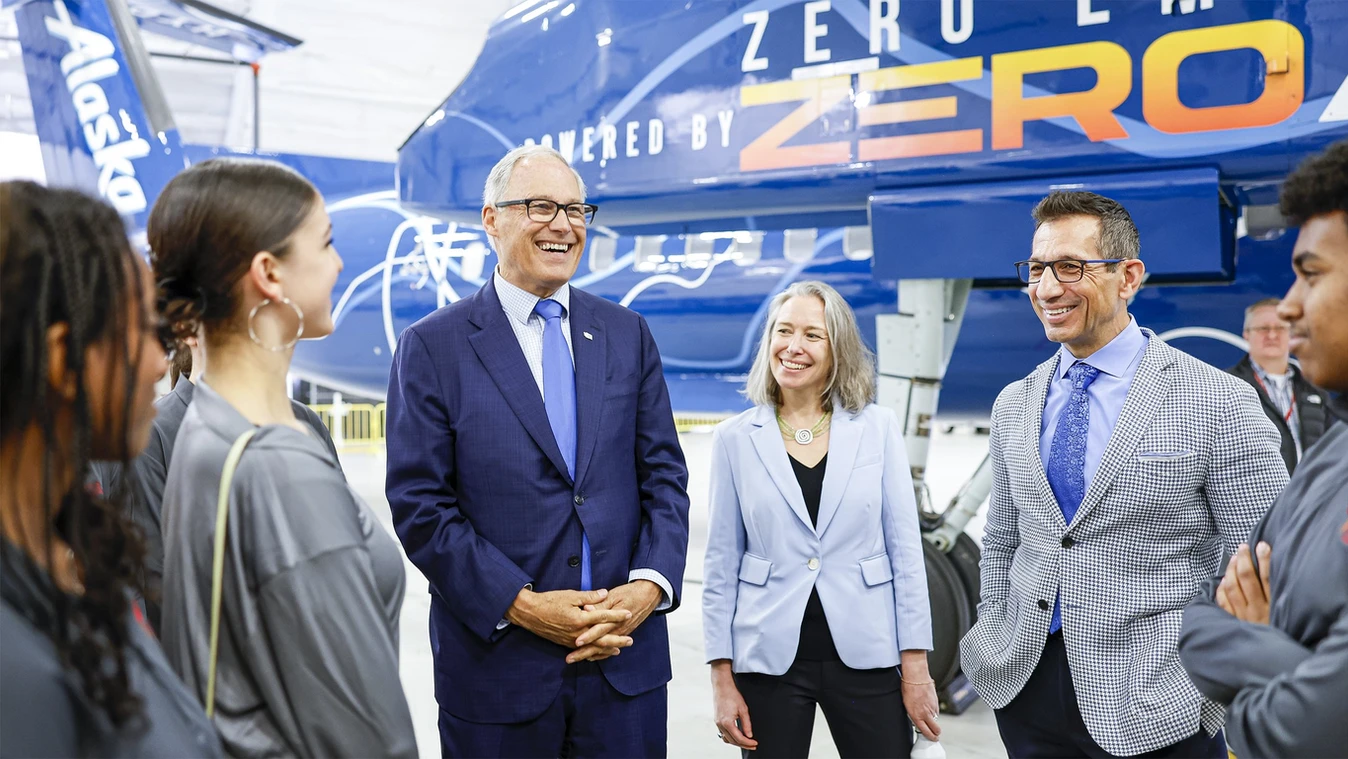
    Everett, WA – May 1, 2023: Alaska Airlines today presented a Bombardier Q400 regional turboprop to ZeroAvia that will be retrofitted with a hydrogen-electric propulsion system in an effort to expand the reach and applicability of zero emissions flight technology.


    At an event held at ZeroAvia’s Paine Field research and development site, the companies were joined by high school students from Raisbeck Aviation High School, Washington State Governor Jay Inslee, Congresswoman Suzan DelBene and Snohomish County Executive Dave Somers to participate in the formal handover of the 76-seat Q400 aircraft that will be developed by ZeroAvia, the U.S.-headquartered leader in designing and building zero-emission, hydrogen-electric aircraft propulsion systems for aircraft.


    When Alaska Airlines’ regional carrier Horizon Air retired its Q400 fleet, it reserved one of the aircraft for research and development purposes to further advance zero emissions technology for the aviation industry. The aircraft was repainted with a special livery to highlight the innovative mission of this partnership.


    ZeroAvia also debuted its breakthrough multi-megawatt modular electric motor system in a 1.8MW prototype configuration at the event – demonstrated with a propeller spin aboard the ZeroAvia’s 15-ton HyperTruck ground-test rig. Combined with higher temperature PEM fuel cells and advanced power electronics – both technologies that ZeroAvia is developing in-house – the leading-edge electric motor technology is one of three key building blocks for enabling commercially-relevant hydrogen fuel cell engines for larger aircraft.

    Ben Minicucci,
    Alaska Airlines CEO, said:

    “This is a great step forward in aviation innovation, to help create a new future of flight – right here at home. Alaska Airlines has defined a five-part journey to achieve net zero carbon emissions long-term, but we can’t get there alone. New technologies are required to make that future possible, and we’re thrilled to partner with industry leader ZeroAvia to make new zero emissions options a reality.”

    Aligning ZeroAvia’s powertrain with the Dash 8-400 airframe will represent a commercially viable zero-emission aircraft with fuel cell engine technology around five times more powerful than what has been demonstrated anywhere to date.

    Val Miftakhov,
    CEO and founder of ZeroAvia, said:

    “Demonstrating this size of aircraft in flight, powered entirely by novel propulsion, would have been unthinkable a few years ago. Launching this program puts us on track for a test flight next year, and accelerates our progress toward the future of zero-emission flight for Alaska Airlines and for the world at large.”

    ZeroAvia’s recent advancements clear the way for a potential flight of the Q400, also recognized as the Dash 8-400, but also demonstrate rapid progress toward certification of the ZA2000 propulsion system. ZeroAvia has already demonstrated a track-record of world-first flight testing. In January, ZeroAvia flew a retrofitted 19-seat aircraft with its prototype 600kW hydrogen-electric engine (ZA600). This followed the demonstration flight of a 250kW system in 2020, which at the time of flight was the world’s largest aircraft flown using a novel zero-emission power source.


    ZeroAvia’s hydrogen-electric engine uses fuel cells to generate electricity from hydrogen fuel, before using that electricity to power electric motors that turn the aircraft propellers. The certifiable ZA2000 system will include ZeroAvia’s High Temperature PEM fuel cells and liquid hydrogen fuel storage, integral to delivering the necessary energy density for commercial operations of large regional turboprops. The company has already established an engineering partnership with De Havilland of Canada, the original manufacturer of the Dash 8 family of aircraft, to enable exchange of data and expertise with the airframe.


    In 2021, Alaska Airlines launched a partnership and invested in ZeroAvia to support the development of zero emissions propulsion technology for regional aircraft. As the fifth largest U.S. airline with a large regional network, Alaska has a unique opportunity to support the development of zero-emissions propulsion technology for regional aircraft. By establishing the viability of regional-sized aircraft, both companies will help advance zero-emissions technology across the industry.

    Jay Inslee,
    Washington State Governor, said:

    “Our state has a rich history of leadership in aerospace, and we’re proud to be at the center of a technological revolution in zero-emission flight. Through innovation and partnerships like the one demonstrated today, we can help write the next chapter of aviation history right here in Washington State.”

    Suzan DelBene,
    Congresswoman (WA-01), said:

    “As we work to meet our emissions reduction goals, we must prioritize decarbonizing the commercial transportation sector. Washington state is leading the nation in developing and deploying clean energy technologies, and the Alaska Airlines—ZeroAvia partnership is a prime example. This collaboration could revolutionize the aviation industry to make our planes greener and our skies cleaner.”

    Dave Somers,
    Snohomish County Executive, said:

    “As a leader in supporting innovative industries, and as the center of aerospace manufacturing in Washington state, Snohomish County is proud to support this partnership and the development of the next generation of aviation technology, driving both job growth and environmental sustainability.”

    HyperCore Motor

    Over the last few weeks at its Hollister location in California, ZeroAvia has been testing its 1.8MW electric propulsion system configuration with the stock Dash 8-400 engine gearbox and propeller. This configuration consists of two “HyperCore” motor modules, each a high-power, high-speed 900kW permanent magnet radial flux machine which operate at 20,000 rpm, matching the typical turbine engine speeds, and providing an unprecedented 15kW/kg motor power density.


    Crucially, HyperCore’s modular design enables the technology to address applications ranging from 900kW up to 5.4MW, meeting a number of regional turbo-prop and regional jet requirements.


    The development and testing program will enable the understanding and measurement of system dynamics, calibration of physical and electrical models, and validation of thermal management systems. The company is concurrently developing world-class silicone-carbide power electronics and the matching hydrogen fuel cell systems, which convert hydrogen to electricity, powering the electric propulsion system. These systems will be brought together to create the full hydrogen-electric propulsion system, tested on the ground and then in the air.

    Subscribe to our Newsletters

    About ZeroAvia

    ZeroAvia is a leader in zero-emission aviation, focused on hydrogen-electric aviation solutions to address a variety of markets, initially targeting a 300-mile range in 9–19 seat aircraft by 2025, and up to 700-mile range in 40–80 seat aircraft by 2027. Based in the UK and USA, ZeroAvia has already secured experimental certificates for its two-prototype aircraft from the CAA and FAA, passed significant flight test milestones, secured a number of key partnerships with major aircraft OEMs and major global airlines, and is on track for commercial operations in 2025. The company’s expanding UK operations are supported by grants from UK’s Aerospace Technology Institute and Innovate UK, and ZeroAvia is part of the UK Government’s Jet Zero Council.


    For more, please visit ZeroAvia.com, follow @ZeroAvia on LinkedIn, Twitter, Instagram, Facebook and YouTube.

    Press Contact

    ZeroAvia Press Team

    press@zeroavia.com

    About Alaska Airlines

    Alaska Airlines and our regional partners serve more than 120 destinations across the United States, Belize, Canada, Costa Rica and Mexico. We strive to be the most caring airline with award-winning customer service and an industry-leading loyalty program. As a member of the oneworld alliance, and with our additional global partners, our guests can travel to more than 1,000 destinations on more than 25 airlines while earning and redeeming miles on flights to locations around the world. Learn more about Alaska at news.alaskaair.com and follow @alaskaairnews for news and stories. Alaska Airlines and Horizon Air are subsidiaries of Alaska Air Group.

    ZeroAvia and Absolut Hydrogen Partner to Develop Liquid Hydrogen Refueling Infrastructure for Aircraft Operations

    Partnership between global Liquid Hydrogen (LH2) transportation leaders Absolut Hydrogen and ZeroAvia supports a roadmap for powering up to 80 seat aircraft by 2027 and the development of robust airport infrastructure.

    Kemble, UK & Seyssinet-Pariset, France: April 17, 2023: ZeroAvia the leader in developing zero-emission solutions for commercial aviation, and Absolut Hydrogen, the leader in liquid hydrogen technologies, today announced a partnership to jointly explore liquid hydrogen (LH2) production, storage and refueling at airports.


    The partners will work together to build and demonstrate liquefaction and liquid hydrogen storage in an airport context and ultimately explore the technology developments, concept of operations, safety procedures and standards for larger-scale deployment to deliver liquid hydrogen to aircraft.


    Grenoble-based Absolut Hydrogen, a subsidiary of Groupe Absolut, is a world leader in developing LH2 systems for heavy-duty mobility for aeronautical, maritime and land applications, building upon Groupe Absolut’s expertise and deep industry knowledge in complex cryogenic systems. Absolut Hydrogen is offering a full LH2 product range with an entry small scale hydrogen liquefaction system (< 50 kg/day), a 100 kg/day Turbo-Brayton based H2 liquefier and a 1T/day liquefier based on the same technology.


    Whilst ZeroAvia’s first certified powertrains for up to 19 seat aircraft will be powered by gaseous hydrogen, ZA2000—a 2–5.4 MW modular powertrain for 40–80 seat aircraft, targeting entry-in-service in 2027—will require liquid hydrogen. This will improve the volumetric energy density of the fuel, enabling support for larger aircraft, flying more passengers, on longer typical routes.


    The move further cements ZeroAvia’s advantage at developing solutions for large regional turboprops and beyond, following the recent announcement of its high-temperature fuel cell technology promising the necessary power for larger aircraft.

    Arnab Chatterjee,
    VP Infrastructure, ZeroAvia, said:

    “As well as building our in-house liquid hydrogen knowledge over the last few months, it has been critical to establish partnerships to begin building the ecosystem that can deliver liquid hydrogen fuel for larger aircraft, at larger airport locations.


    Retaining and growing aviation will bring us all closer together and keep the world small, but it depends upon this quest for zero-emission aviation being successful.”

    Jérôme Lacapère,
    CEO of Absolut Hydrogen, said:

    “This partnership with ZeroAvia is an opportunity to take a new step towards a more sustainable aviation.


    Liquid hydrogen is considered the most advantageous state for tomorrow’s aviation and heavy-duty mobility in general, and Absolut Hydrogen enables its availability thanks to its H2 liquefiers.


    I am convinced this partnership will lead to new standards on liquid hydrogen infrastructure for aircraft.”

    Subscribe to our Newsletters

    About ZeroAvia

    ZeroAvia is a leader in zero-emission aviation, focused on hydrogen-electric aviation solutions to address a variety of markets, initially targeting a 300-mile range in 9–19 seat aircraft by 2025, and up to 700-mile range in 40–80 seat aircraft by 2027. Based in the UK and USA, ZeroAvia has already secured experimental certificates for its two-prototype aircraft from the CAA and FAA, passed significant flight test milestones, secured a number of key partnerships with major aircraft OEMs and major global airlines, and is on track for commercial operations in 2025. The company’s expanding UK operations are supported by grants from UK’s Aerospace Technology Institute and Innovate UK, and ZeroAvia is part of the UK Government’s Jet Zero Council.


    For more, please visit ZeroAvia.com, follow @ZeroAvia on LinkedIn, Twitter, Instagram, Facebook and YouTube.

    Press Contact

    ZeroAvia Press Team

    press@zeroavia.com

    About Groupe Absolut

    Groupe Absolut is a worldwide leader of innovative cryogenic solutions (between -180°C and -271°C) for research and industry. Its ambition is to develop cryogenic innovations to accelerate the energy transition. Groupe Absolut’s origin is the subsidiary Absolut System, which develops ultra-complex and customized cryogenic equipment for 13 years. Recently, Groupe Absolut has created three other subsidiaries specialized in markets with high growth potential: liquid hydrogen, NewSpace earth observation and superconductivity. Absolut Hydrogen offers liquid hydrogen solutions for mobility and remote energy generation, and Absolut Sensing, which operates satellites for the detection of greenhouse gas emissions (methane). Recently, Absolut Quanta (low-energy consuming supercomputers) has been created with the objective of decarbonizing the data processing industry while improving its performances. With its international scope and its involvement in many strategic projects (France 2030, EU project call “Copernicus”…), Groupe Absolut is actively developing highly innovative solutions for environmental control, new energies (nuclear fusion, hydrogen) and quantum digital technology. Its clients include leading companies such as Airbus, Thalès, Safran, and CFS, and agencies such as CNES, ONERA, DGA, ESA and NASA.


    For more, please visit Groupe-Absolut.com, follow @GroupeAbsolut on Twitter and LinkedIn.

    About Absolut Hydrogen

    Absolut Hydrogen is a French industrial engineering SME based in Grenoble. As a subsidiary of Groupe Absolut, Absolut Hydrogen aims to make liquid hydrogen accessible for the decarbonization of the industrial and mobility sectors.


    Thanks to the know-how of Groupe Absolut, it is today the only independent entity positioned on the LH2 market with a multi-sector application expertise in cryogenics.


    For more, please visit absolut-hydrogen.com, follow @AbsolutHydrogen on Twitter and LinkedIn.

    ZeroAvia Strikes Deal to Bring Zero-Emission Flights to Sweden

    Zero-emission aviation engine pioneer partners with Braathens Regional Airlines, Skellefteå Airport and Skellefteå Kraft to deliver green flights

    Hollister, Calif. & Kemble, UK, March 29, 2023: ZeroAvia, the leader in developing zero-emission solutions for commercial aviation, today announced a four party agreement to develop commercial routes using its hydrogen-electric powertrain systems on routes from Skellefteå Airport in Northeast Sweden. As part of the agreement, ZeroAvia will work with the airport, the municipal energy company Skellefteå Kraft and Braathens Regional Airlines to demonstrate flights and explore launching commercial operations.

    Braathens Regional Airlines, one of the largest domestic operators in Sweden, plans to provide aircraft for future demonstrations and to explore commercial routes. The partners will examine the potential for operating a range of regional aircraft on commercial passenger routes using both ZeroAvia’s ZA600 powertrain, designed for 9–19 seat aircraft with a 2025 launch target, and its ZA2000, designed for 40–80 seat aircraft (such as ATR and Dash 8 families), with a plan for entry into service by 2027. Braathens Regional Airlines currently operates 14 ATR-72 aircraft on routes across Sweden, Finland and Denmark and will in the coming months start up charter flights operating 8 Airbus 319/320.

    Skellefteå Airport is one of the ten largest airports in Sweden in terms of domestic flight operations. In conjunction with the partners, the airport will investigate the operational infrastructure required to support the hydrogen-powered flights and opportunities for further decarbonisation presented by green hydrogen.

    Skellefteå Kraft has deep experience of renewable generation in the region, with hydroelectric power stations in operation and the Blaiken onshore wind farm as part of its portfolio. The energy company will analyze the potential for hydrogen production and supply as part of the project with ZeroAvia.

    Hydrogen-electric propulsion promises lower operating costs and zero-emission flights for airlines, as well as reduced air and noise pollution around airport locations. These benefits can in turn mean greater use of regional air travel, increasing productivity and connectivity and providing a boost for regional economies.

    James Peck, CCO ZeroAvia

    James Peck, Chief Customer Officer, ZeroAvia, said:

    “Sweden is one of the most ambitious countries in the world in pursuit of net zero targets for aviation, with an overall fossil fuel-free aspiration by 2045, and planning for all domestic flights to be fossil free by 2030. Aviation will become a larger proportion of emissions as other sectors abate, so the country will need to see true zero emission air travel that goes beyond combustion fuels. Bold projects such as the one planned for Skellefteå are crucial in this endeavour.”

    Ulrika Matsgård,
    CEO, Braathens Regional Airlines, said:

    “To achieve our airlines’ ambitious goals to reach net-zero for our international flights by 2045, we need to speed up the development of technology. We see hydrogen-powered aircraft as one important solution for international flights in Europe. It’s also important for us to contribute to initiatives started here in the Nordics.”

    Joachim Nordin,
    CEO at Skellefteå Kraft, said:

    “Skellefteå Kraft wants to contribute to the energy transition for sustainable aviation. We are still in a very early stage regarding hydrogen but think that renewable hydrogen is a possibility and a part of the solution to energy and climate change challenges.”

    Ann-Christine Schmidt,
    Head of R&D and Hydrogen at Skellefteå Kraft, said:

    “By reviewing the conditions together with ZeroAvia, Skellefteå Airport and Braathens Regional Airlines, we will more quickly increase understanding and our readiness to support future hydrogen-powered aircraft.”

    Robert Lindberg,
    CEO Skellefteå Airport, said:

    “We see an increasing travel demand in the northern part of all Nordic countries. If we manage to test, develop and commercialise hydrogen aviation solutions in Skellefteå, we can help to increase regional connectivity in a truly sustainable way.”

    The project in Sweden is further traction for ZeroAvia’s plans to introduce its zero-emission propulsion technology on regional routes over the next few years, with partnerships with Rotterdam The Hague Airport in the Netherlands, Edmonton International Airport in Canada, and AGS and Birmingham Airports already in place.

    The company has also secured in excess of 1,500 provisional orders for its hydrogen-electric powertrains over the course of the last 18 months, including deals with American Airlines, United AirlinesAlaska AirlinesRed Sea Development CompanyRavn AlaskaMONTERose CayASL Ireland and a number of other operators and lessors.

    Subscribe to our Newsletters

    About ZeroAvia

    ZeroAvia is a leader in zero-emission aviation, focused on hydrogen-electric aviation solutions to address a variety of markets, initially targeting a 300-mile range in 9–19 seat aircraft by 2025, and up to 700-mile range in 40–80 seat aircraft by 2027. Based in the UK and USA, ZeroAvia has already secured experimental certificates for its two-prototype aircraft from the CAA and FAA, passed significant flight test milestones, secured a number of key partnerships with major aircraft OEMs and major global airlines, and is on track for commercial operations in 2025. The company’s expanding UK operations are supported by grants from UK’s Aerospace Technology Institute and Innovate UK, and ZeroAvia is part of the UK Government’s Jet Zero Council.


    For more, please visit ZeroAvia.com, follow @ZeroAvia on LinkedIn, Twitter, Instagram, Facebook and YouTube.

    Press Contact

    ZeroAvia Press Team

    press@zeroavia.com

    ZeroAvia and Fortum Explore Hydrogen Airport Refueling Infrastructure Across the Nordics

    • Partnership brings zero-emission flights one step closer

    Kemble, UK – March 20, 2023: ZeroAvia today announced that it has signed a Memorandum of Understanding with the Nordic energy company Fortum to explore developing hydrogen production and refueling infrastructure at airports in the region. The companies will work together with a view to building a network of zero-emission flight routes.


    As part of the collaboration, ZeroAvia and Fortum will investigate the potential development of on-the-ground hydrogen infrastructure at relevant airports with the aim of removing emissions from both flights and the wider airport ecosystem. On-airport hydrogen infrastructure can also support complementary traffic from heavy-duty transportation, materials handling equipment and other energy consuming systems. Any future decisions on possible investments will be made at a later stage.


    Fortum is a Nordic energy company that produces and delivers clean energy, working together with industries on their decarbonization as part of the transition to net zero societies. Fortum’s core operations in the Nordics comprise efficient, CO2-free power generation as well as reliable supply of energy to private and business customers. This positions Fortum strongly to deliver the capacity required for the production of green hydrogen, a crucial ingredient for tackling aviation’s climate change impact.


    ZeroAvia is leading the race to deliver zero-emission engine technology for passenger and cargo-carrying commercial aircraft, with a target of certifying its engines first for 9–19 seat aircraft by 2025, followed by 40–80 seat aircraft by 2027.


    With a rich vein of encouraging policies and targets for the adoption of cleaner flight, Nordic countries will be among early adopters of zero-emission flights.

    Arnab Chatterjee,
    VP Infrastructure, ZeroAvia, said:

    “As hydrogen hubs, airports can help reduce climate and air quality impacts of flight and a raft of other operations. Scaling the renewable energy capacity and reducing costs pose clear, but fully surmountable, challenges to hydrogen as the fuel to power truly clean flights. Fortum is well positioned as a partner in this space, given the company’s clean energy focus and its emerging hydrogen leadership.”

    Torbjörn Wilén,
    Senior Manager, Hydrogen Business Development, Fortum, said:

    “ZeroAvia is a leader both in demonstrating clean flight, and in building the model for how hydrogen refueling will work in aviation. We believe that ZeroAvia and Fortum together can explore excellent options for clean aviation, both on the ground and in the air.”

    ZeroAvia has already demonstrated its world-first Hydrogen Airport Refueling Ecosystem (HARE) at its R&D hub in Kemble in the UK, and is working with a range of airports on projects to establish the infrastructure and operations to operate zero-emission routes as early as 2025.

    Subscribe to our Newsletters

    About ZeroAvia

    ZeroAvia is a leader in zero-emission aviation, focused on hydrogen-electric aviation solutions to address a variety of markets, initially targeting a 300-mile range in 9–19 seat aircraft by 2025, and up to 700-mile range in 40–80 seat aircraft by 2027. Based in the UK and USA, ZeroAvia has already secured experimental certificates for its two-prototype aircraft from the CAA and FAA, passed significant flight test milestones, secured a number of key partnerships with major aircraft OEMs and major global airlines, and is on track for commercial operations in 2025. The company’s expanding UK operations are supported by grants from UK’s Aerospace Technology Institute and Innovate UK, and ZeroAvia is part of the UK Government’s Jet Zero Council. 


    For more, please visit ZeroAvia.com, follow @ZeroAvia on LinkedIn, Twitter, YoutubeInstagram, Facebook

    Press Contact

    ZeroAvia Press Team

    press@zeroavia.com

    ZeroAvia High Temperature Fuel Cell Testing Shows Large Aircraft and Rotorcraft Potential for Hydrogen-Electric Propulsion

    • World-first pressurized HTPEM fuel cells achieve record-breaking power densities
    • Development unlocks large turboprop and regional jet applications, and could unlock single-aisle, zero-emission aircraft within 10 years

    Kemble & Sandwich, UK: March 9, 2023: ZeroAvia today announced that it has achieved record-breaking performance in testing of its High Temperature Proton Exchange Membrane (HTPEM) systems. Early testing of the pressurized 20kW HTPEM stack power module in ZeroAvia’s UK R&D location has demonstrated a record 2.5 kW/kg specific power at the cell level, paving the way for 3+ kW/kg system level densities in the next 24 months.


    Developing fuel cell technology for aviation is critical to enable true zero-emission commercial flight, and for energy intensive applications – like large fixed wing aircraft and rotorcraft – it is necessary to increase the temperature and pressure within fuel cell stacks in order to have a commercially viable product. Increased temperature and pressure allows for air cooling, reduces cooling drag, simplifies the system, and ultimately enables much more demanding applications.


    ZeroAvia’s team has made unprecedented deep tech breakthroughs by delivering a pressurized HTPEM system, innovative conductive coatings enabling the use of aluminum bipolar plates in highly aggressive HTPEM environments, and a novel approach to advanced membrane electrode assembly (MEA).


    ZeroAvia’s proprietary technology has been developed over the last three years as part of a concentrated effort to build an in-house portfolio of critical technologies for fuel cell aviation at ZeroAvia. Further R&D will deliver over 3kW/kg fuel cell system specific power, which enables a step change in performance relative to the traditional fuel cell technologies, making fuel cell propulsion commercially viable for large aircraft. Specifically, the HTPEM systems will be prime candidates to support ZeroAvia’s ZA2000 powertrain for 40-80 seat aircraft, as well as a range of rotorcraft and eVTOL applications. This next generation of fuel cells could also be sufficient to enable electric propulsion systems for 100+ seat single-aisle turbofan aircraft such as the Boeing 737 and Airbus A320.


    The components used in the ZeroAvia system have already been validated through third-party independent testing at several independent labs, including a leading U.S. Department of Energy national lab. The testing confirms the potential for HTPEM systems to accelerate the development of large hydrogen-electric powertrains for large aircraft.


    ZeroAvia’s recent breakthrough first flight of a 19-seat aircraft utilized Low Temperature PEM (LTPEM) fuel cell systems. Today’s LTPEM systems work well for the sub-megawatt scale of these smaller aircraft, but the lower stack core temperatures make it harder to remove heat from the larger systems. HTPEM technology eliminates a number of components from the fuel cell system and reduces cooling drag, thereby enabling commercially relevant payload and range. ZeroAvia’s HTPEM can also offer greater durability, further reducing operating costs for airlines.

    Val Miftakhov,
    CEO and founder of ZeroAvia, said:

    “The companies and geographies that seize the lead in high fuel cell temperatures and pressures will lead the industry. This progression is similar to the story of turbine engines, where ever-increasing temperatures and pressures drove higher and higher performance. Hydrogen fuel cell propulsion is the most environmental and economical alternative to existing engines, and HTPEM is the most promising route to delivering these benefits into large aircraft categories. I am confident that what we are demonstrating now is the core building block to delivering zero-emission flight for all categories of aircraft in the long-term.”

    Interest in hydrogen aviation has grown considerably in recent months. Hydrogen combustion engines are being developed to remove carbon emissions from flight, but they face the steep environmental penalty of maintaining or increasing the non-CO2 emissions impacts of aviation on the climate. These non-CO2 impacts are thought to have twice the climate impact of carbon emissions alone, according to a report from EASA. Additionally, a non-combustion, hydrogen-electric approach eliminates extreme material stresses inherent in modern combustion engines, which dramatically reduces maintenance costs, further improving the economics of the hydrogen-electric propulsion.


    ZeroAvia’s development of the HTPEM systems is in part supported by the HyFlyer II project, backed by the UK Government via the Aerospace Technology Institute (ATI).

    Subscribe to our Newsletters

    About ZeroAvia


    ZeroAvia is a leader in zero-emission aviation, focused on hydrogen-electric aviation solutions to address a variety of markets, initially targeting a 300-mile range in 5–20 seat aircraft by 2024, and up to 1000-mile range in 40–80 seat aircraft by 2026. Based in the UK and USA, ZeroAvia has already secured experimental certificates for its two-prototype aircraft from the CAA and FAA, passed significant flight test milestones, secured a number of key partnerships with major aircraft OEMs and major global airlines, and is on track for commercial operations in 2024. The company’s expanding UK operations are supported by grants from UK’s Aerospace Technology Institute and Innovate UK, and ZeroAvia is part of the UK Government’s Jet Zero Council. For more, please visit ZeroAvia.com, follow @ZeroAvia on TwitterInstagram, and LinkedIn.

    Press Contact

    press@zeroavia.com